Top Signs You Need Garage Door Service – Don’t Ignore These
A door that takes two seconds longer to open than it did six months ago isn’t “just getting older.” It’s a motor working against resistance that will either snap a cable or burn out the opener, usually on a morning you’re already running late. Most garage door failures announce themselves weeks in advance, and homeowners routinely mistake those signals for normal wear. The good news: every one of those warning signs is diagnostic data you can read before the failure happens. If you’d rather not DIY the diagnosis, call (855) 475-0589 and we’ll sort it out.
What Sound Is Your Door Making? A Noise-by-Noise Diagnosis
Grinding means metal is being shaved into shavings and metal is losing the fight. Squealing means a roller, hinge, or bearing has lost lubrication. Popping usually points to a torsion spring that’s starting to go, and rattling means something has loosened. The noise itself tells you what’s failing, which is why we listen carefully before we open a toolbox.
A healthy garage door is fairly quiet in Renton. It hums along the track. Once it starts talking, it’s telling you something. Here’s how to translate:
- Grinding: Metal-on-metal contact, often a worn bearing plate or a roller that’s seized and dragging against the track. Keep running it and the friction fights the opener motor directly.
- Squealing or squeaking: Usually a dry hinge, roller, or a bearing that’s lost its lubrication. This one is often cheap to fix early and expensive to ignore late.
- A sharp popping or snapping sound: A torsion spring beginning to fail. That pop may be the last warning you get before it lets go entirely. A snapped spring is under extreme tension and is not a safe DIY job.
- Rattling that worsens over time: Loose bolts, loose track brackets, or a worn hinge. The sound tracks how much the vibration has progressed.
- Banging when the door meets the floor: The door is slamming instead of easing down, which stresses the panel seams and the opener gears.
If a Genie or LiftMaster opener sounds like it’s straining more than it used to, that’s a signal too: the motor is compensating for resistance somewhere in the door itself.
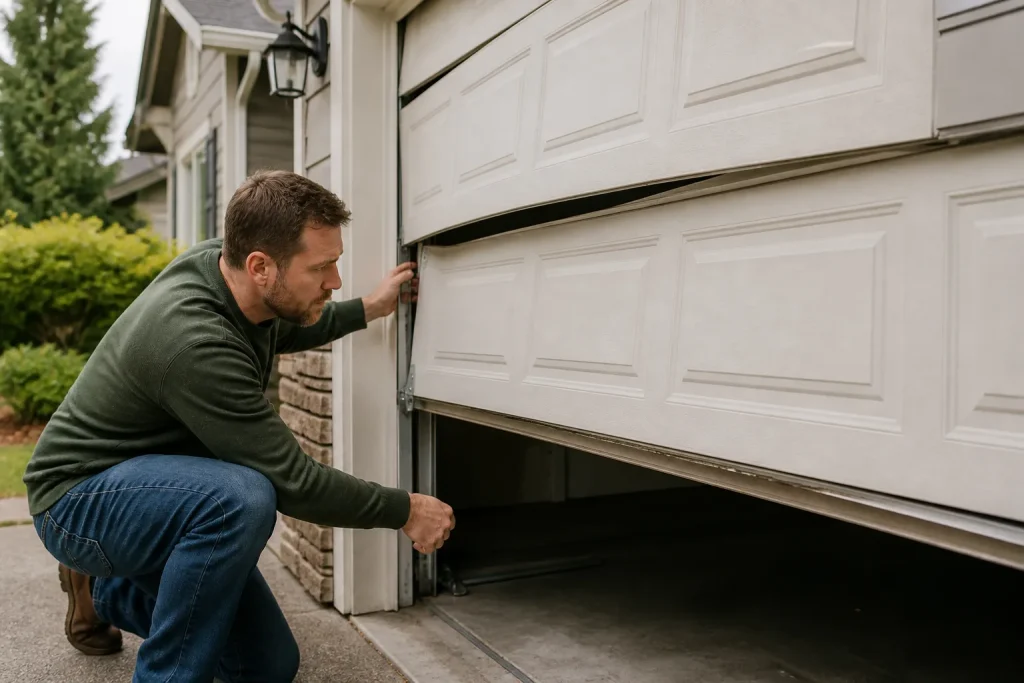
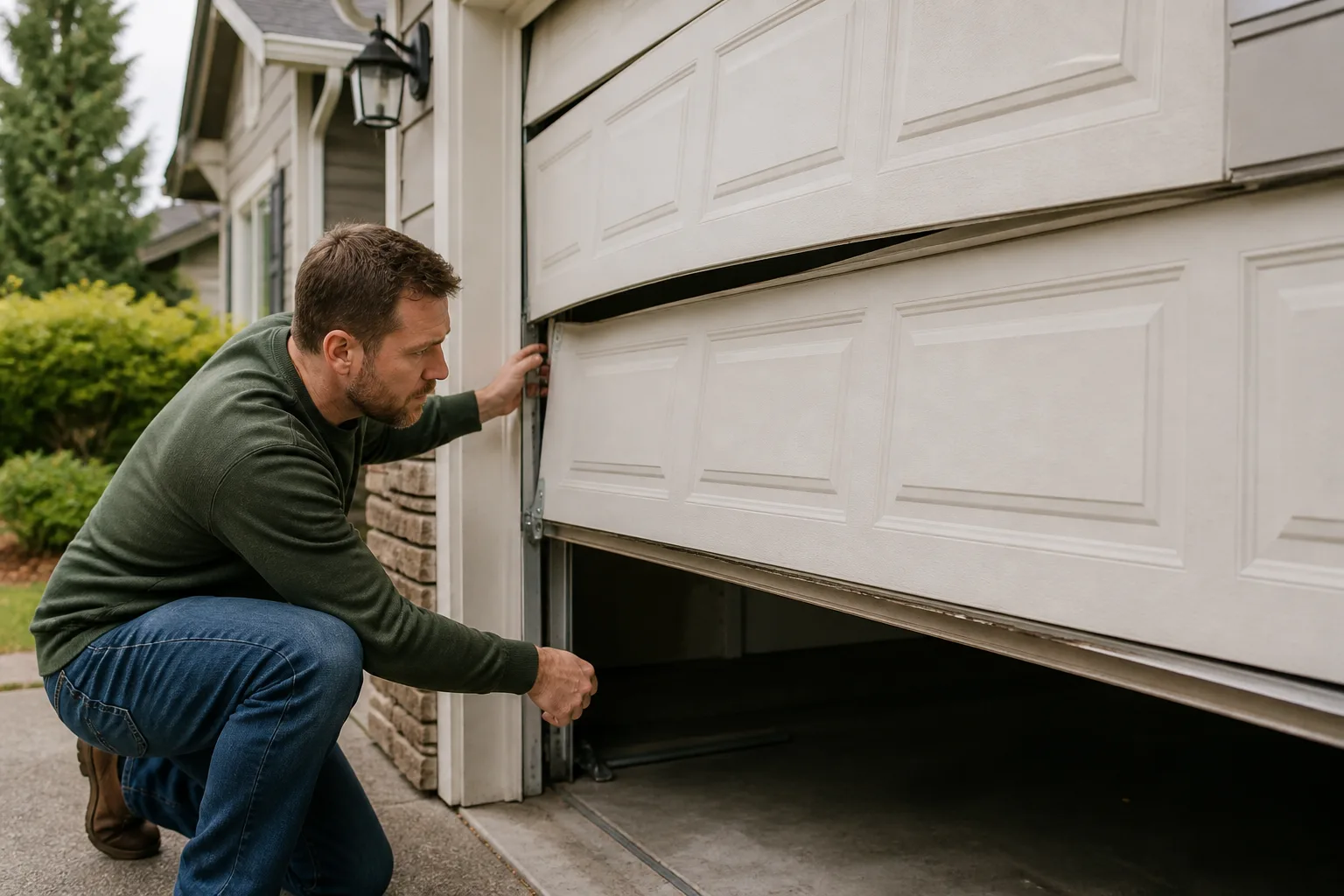
A Door That’s Slightly Off-Level Is Rarely Just a Door Problem
A door that hangs a little low on one side is a cable or drum problem in its early stages. When the cables aren’t pulling evenly, the door tilts, the drum winds unevenly, and the springs carry uneven tension. In the late stage, that inequality is exactly how a full spring failure happens.
Here’s how the escalation usually unfolds:
- Early: You notice the door doesn’t quite sit even at the floor, or one side seems to lag. The cables or drums are likely out of balance. A trained look now costs far less than the aftermath.
- Middle: The door binds, the opener strains, and the panels start rubbing. You may hear a grinding that wasn’t there before. Don’t reinforce this by using the opener as a hammer.
- Late: A cable slips or a spring breaks. The door can come down hard or stay locked in place. This is the call that happens at an inconvenient hour, and this is when emergency garage door service matters.
In Renton, a door that’s off-level usually drifts there slowly over a wet winter. We’ve seen plenty of Amarr and Wayne Dalton doors where a small cable issue sat quietly for months before it announced itself. If the door’s not hanging square, get it looked at before it decides to tell you itself.
Opener Behavior That Predicts a Motor Failure 30 – 90 Days Out
Most opener motors announce their decline early. The door slows down, the motor sounds labored, the remote works at shorter range, or the lights flicker when the door starts. These are the predictable signs, and if you catch them early enough they usually mean a repair, not a full replacement.
What to watch for:
- The door moves slower than it used to. The opener is straining against added resistance somewhere in the door, which is often the door’s problem translating through the motor.
- The motor is hotter than it should be. The housing feels warmer than usual after a few cycles. That heat is lost efficiency.
- The remote only works when you’re close. A sign of aging electronics or antenna issues, not just a low battery.
- The opener reverses or stops partway through the cycle. The travel limits or force settings are drifting, or the motor is struggling.
- You hear a hum without movement. That’s the motor trying and failing, usually before it stops entirely.
If it’s a Genie or Chamberlain unit that’s doing this, call us before the motor burns out completely. Catching an opener 30 to 90 days out usually means a straightforward repair. Waiting means replacing it. Our garage door opener repair work covers all of these brands, and knowing the machine is half the diagnosis.
How Renton’s Wet Winters Accelerate Specific Failures
Renton’s wet winters give garage doors a particular kind of wear: constant moisture and temperature swings that find the weak points. Rust starts where water hangs around: the spring coils, the cable strands, and the bottom brackets and hinges near the floor.
Three things you can safely check yourself:
- Look at the springs. If the coil is showing visible orange-brown rust or pitting, moisture has been sitting in the metal. Rusted wire loses strength quietly.
- Look at the cables. Cables should look clean and even. Frayed strands or a thick coat of rust are warning signs. Don’t touch or tension them yourself.
- Look at the bottom of the door and the hinges. Rust staining around the bottom brackets and lower hinges is common after a wet winter in Renton.
What you shouldn’t do is lubricate or tension anything under load. Springs and cables are under extreme tension, and a rust-weakened spring that lets go is an injury risk, not a maintenance inconvenience. Our spring work is handled by trained technicians because that specific job punishes shortcuts. If you’re spotting rust, it’s time for a look, not a can of spray.
The “It Still Works” Trap: Functional Doesn’t Mean Safe
A door that still opens and closes can still be an injury risk. “It still works” is the most expensive phrase in this trade, because it delays the fix until the door fails in the worst place at the worst time.
The specific conditions where a working door isn’t safe:
- The auto-reverse doesn’t work when it meets an object.
- The door is off-level or uneven at the floor.
- A spring shows visible rust or you hear popping.
- Cables look frayed or uneven.
- The opener strains or the motor hums without moving.
If any of these describe your door in Renton, it’s time for a proper look. We work on your brand, and the right fix, not the easy fix, is what we aim for. When the door won’t move at all, that’s what emergency garage door service is for. For the routine stuff, our garage door repair covers everything from a stubborn track to a snapping cable.
When to Call a Pro (and When It’s Just a Lubrication Job)
If the problem is a squeaky hinge and a clean track, that’s maintenance, and a homeowner can handle the light stuff. If the problem involves springs, cables, drums, or a door that’s off-level, call a professional. The danger is real, the fix is precise, and there’s no safe shortcut.
When you do call, the diagnosis is faster if you describe the sound and the behavior. That’s why we ask. It’s also why being a garage door specialist matters: we work only on doors, every day, so we know the difference between a noise that means “lubricate” and a noise that means “stop using this door.”
Related services in Renton: if the door itself is beyond repair and it’s time for a new one, our garage door installation team handles Clopay, Amarr, and other name brands with a proper measurement and a written price before any work starts.
The Bottom Line
Garage door failures rarely come out of nowhere. They whisper first: a grinding note, a door hanging two inches off-level, a motor that’s working a little too hard. The signs to act on are rust on springs, uneven cables, an opener that’s slowing down, and any door that’s still working but no longer behaving. Catch them early and the fix is usually small. Ignore them and they escalate into a snapped spring or a dead motor, usually at the worst possible moment.
Free estimates, and the price is quoted and agreed before any work starts. If you’re in Renton and need help, Renton Garage Door Repair Co offers free estimates – call (855) 475-0589.
Frequently Asked Questions
The earliest signs are usually sound and speed: a grinding or squealing noise that wasn’t there before, and a door that moves more slowly than it used to. A door that’s slightly off-level is also an early signal, usually pointing to a cable or drum issue.
Yes. A door that’s off-level, has rusted springs, or fails the auto-reverse test can still open and close, but it’s a risk. Functional and safe are two different things. If any of those warning signs are present, stop using the door until a technician looks at it.
A popping sound often points to a torsion spring that’s starting to fail. It can also indicate a cable that’s slipping or a track that’s shifting. Because springs are under extreme tension, have it checked by a trained technician rather than investigating it yourself.
If the door slows down gradually, the motor hums before it moves, or the remote range shrinks, that’s usually repairable. If the motor has already stopped completely or the housing is cracked, replacement is the more sensible route. Every brand we handle, including Genie and Chamberlain, gets the same careful diagnosis before we recommend either.
Written by the team at Renton Garage Door Repair Co.
Need Garage Door Help?
Call Renton Garage Door Repair Co - the local pro we connect you with is licensed and insured, here with fast after-hours help in Renton.
(855) 475-0589